Korean as my 6th language?

Greetings Everyone,

After a two-year hiatus, I am delighted to share that I have embarked on a journey to learn my sixth language: Korean. You might wonder, why embark on this new endeavor? Wasn’t mastering five languages enough? Does she still have the desire to study?

I would like to share my latest interest, which seems to be a growing trend—Korean dramas (K-dramas) on Netflix. As I listen to them in their original version with Italian subtitles, I find myself captivated by the sound of the Korean language.

Firstly, let me explain why I watch K-dramas:

Contrary to what one might assume, I do not watch them for their romantic elements or the attractiveness of the characters. My interest lies elsewhere. I find myself weary of the violence depicted in American and other international series and movies, which often showcase guns, murders, and drugs. In these tumultuous times, I prefer to immerse myself in the peaceful and soothing world of K-dramas. While K-dramas can evoke deep emotions and may even bring tears, they do not elevate stress levels as Western media does. They focus on personal strength, energy, and emotions rather than on crime and violence.

Secondly, let me explain why I decided to study the Korean language:

As I listened to the Korean language, I found its sound appealing. I began to identify linguistic elements, aided by the Italian subtitles. However, subtitles often summarize the dialogue, leading me to notice differences between what was said and what was written. For instance, expressions like “Thank you” and “I am hungry” sounded different from their textual counterparts. Moreover, I was fascinated by the various ways Koreans address people, similar to our formal and informal speech.

Through my study, I discovered that Korean has multiple speech levels, influenced by the vertical hierarchy of Confucianism, where age and social status play significant roles. This piqued my curiosity, and I felt compelled to delve deeper.

Thirdly, I have always been intrigued by Korean symbols and writing:

To understand Korean writing, I started with the alphabet, which comprises 40 letters (19 consonants and 21 vowels). What struck me as elegant and fascinating is that the letters are formed by three symbols: a vertical line (“I”) representing humans, a dash (“-“) representing the earth, and a dot (“.”) representing the sky. Additionally, the concept of bright and dark letters is inspired by the yin and yang philosophy, which is truly remarkable.

So, no, five languages are not enough for me, and I am eager to study more. When you are passionate about something, learning it becomes effortless and enjoyable.

What about you? Have you developed any new interests lately? Are you ready to embark on a new journey?

Korean Phrase: 곧 보자, 안녕 English Translation: See you soon, goodbye

Image created by AI.

Formal vs Informal

Hello everybody!

Today I got to think about personal pronouns and how they are used differently according to the language you speak. I’ll clarify. I’m referring in particular to the personal pronouns (You-second person singular and plural/he/she) that we use in both formal and informal contexts. In our daily conversations using the correct form is important because it can denote intimacy, distance or higher/lower social rank. I speak four other languages, Italian, Spanish, Portuguese and Norwegian, and I’d like to explain very briefly below the use of these pronouns in formal vs informal situations.

In Italian, we use the pronoun lei (third person singular) in formal situations and we use it with people we don’t know, such as authorities or high-level professionals. In a conversation with friends and family, we use tu (you, second person singular) instead.

In Spanish, they use usted (you) as a formal pronoun. I’ve lived seven years in Spain and if you have ever had the chance to get to know Spanish people or live in their wonderful country you’ll have perhaps noticed how friendly these people are. In fact, even if the formal pronoun should have been used in formal situations, using an informal pronoun such tú (you) is still okay. But I did meet people, such as professors, who still like to use the formal way.

Instead, in some countries of Latin America, they still use usted even in informal instances or vos (you) from voseo (this is the use of the pronouns vos in place of tú or vosotros in combination with the verb conjugated in the 2nd person plural) .

In Norway, du (you) is always used no matter the context or social rank, like in English today. The form de is a very old form which is not used anymore, as thee in English.

In Portuguese, the general rule is the same as in Spanish : tu (you) for informal situations, você (you) for formal situations. But in Brasil they always use the formal way você/vocês (you-second person singular and plural) for both formal and informal situations. 

Personally, I like to use the informal way as in Norwegian and in English, I feel comfortable with it because I think that giving importance to social rank or expressing distance is not necessary.  Respect should not be defined by grammar or by the use of formal pronouns. We can respect someone simply by using the right words.

How amazing are languages? And how hard is it to learn and remember all those rules?

What do you prefer to use: formal or informal way? What do you think?

I would love to read your opinions.  

Source

You have to read this!

Hello everyone!

Still in lockdown? Here in Norway, we still are 😦

There are a lot of things we could do at home, but one thing I adore is to pick up a nice book to read. What about you?

Lately I have been reading books about the philosophy of life which makes me see things more rationally and positively. This way of thinking helps a lot especially if you are going through some hard times.

The book I would like to mention to you today tells the story of a woman, with three children, struggling to juggle her everyday responsibilities as both a wife and a mother. Throughout the story, which is written in the form of a diary, we witness her attempt to improve intimacy with her husband, regrettably in vain. The events unfold as we go through the main character’s reflections and as we flip through the pages, we are reeled into her world and feelings which make the book more realistic. What I liked the most was her spontaneity in telling the events and her way of showing her real identity through her thoughts, which are the essence of this story. Her name is Paz and the title of the book is “Mama’ en busca del polvo perdido” (English: Mom in search of lost sex) by Jessica Gomez, a Spanish author.

First, I would like to share with you the news that I am part of two groups of Spanish women who talk about female sexuality and the period. During our meetings, we can speak freely about all sorts of things that revolve around the intimate phases of our life. The groups’ names are “Sex community” & “Mis 4 lunas” (My 4 moons), and sometimes our leaders suggest us reading  a book as homework.

Here below, you’ll find a paragraph of the book I chose to read, and this is the part I want to share with you. This way, you may have a better idea of the content in case you are looking for similar books to read. 😊

Source

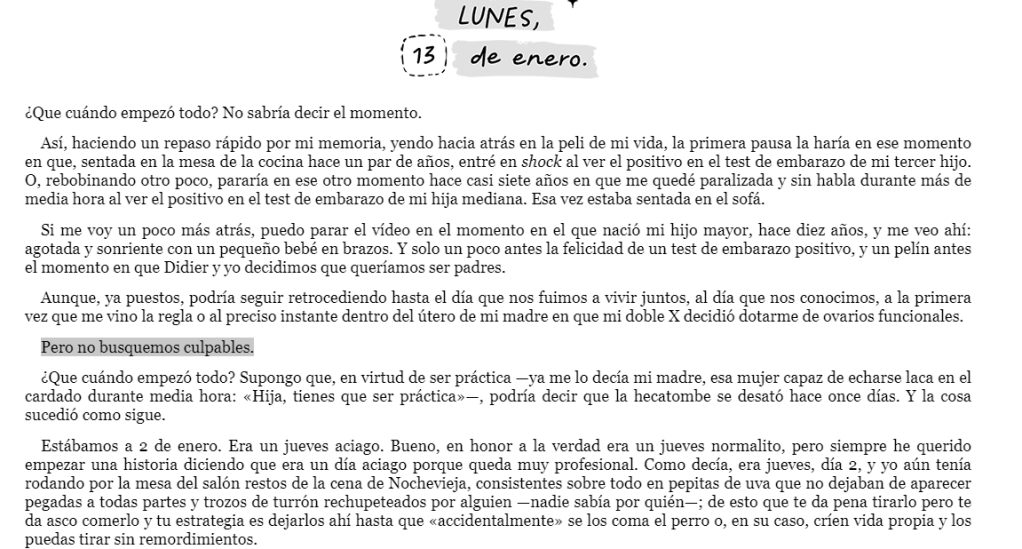
MONDAY,

January 13th.

You ask when did everything start? I wouldn’t know when.

Well, doing a quick review of my memory, going back to the movie of my life, I would first stop on the moment when, sitting at the kitchen table, a couple of years ago, I was shocked when I saw the positive pregnancy test of my third child. Or rewinding a bit more, I would stop at another moment, seven years before, when I got paralyzed and speechless for more than half an hour while I was looking at the positive pregnancy test of my middle daughter. At that time, I was sitting on the couch. If I turn back a little more, I can stop the movie at the moment when my oldest son was born, ten years ago, and I see myself there: exhausted but smiling with a baby in my arms. And a bit before that, seeing the happiness of a positive pregnancy test, and a bit earlier when Didier and I decided to be parents.

And now that we are at this point, I could go back to the day when we went to live together, to the day when we met each other, to the first time that I got the period or to the exact moment inside of the uterus of my mother where my double X decided to give me functional ovaries.

But let’s not try to look for the guilty.

Are you asking me when it all started? I suppose that, by being practical- my mom, that woman, able to put lacquer on that carded hair for half an hour, already told me that: ” Daughter, you must be practical”-, I could say that the massacre was unleashed eleven days ago. And the thing happened as follows.

It was the 2nd of January, a fateful Thursday. Well, to be honest, it was a normal Thursday, but I have always wanted to begin a story by saying that it was a fateful day because it looks very professional. As I was saying, it was Thursday, the 2nd, and I still had the remains of the New Year’s Eve dinner rolling around the living room table. They were consistent especially in grape seeds that did not stop appearing glued everywhere with pieces of nougat well sucked by someone- nobody knew by whom-; with the feeling of sadness to throw it away even if it sucked to eat it, but my strategy was to leave them there till the dog could “accidentally” eat them or, in their case, they could have their own life and you could throw them away without any remorse.

(…)

How does it sound to you? I hope you’ll get a chance to read it whether in Spanish or in English. I’ll leave here below the links in case you are interested:

mamá En Busca Del Polvo perdido: Amazon.es: Gómez, Jessica: Libros

Also you can search for Ana Galvez Rodriguez and Laura Solas Fernandez on Facebook and Instagram 🙂 if you want to learn more about their interesting female world 🙂

Ana Gálvez Rodríguez | Facebook

Laura Solas Fernandez | Facebook

HAPPY READING!

Source

PAPARAZZI

Hello everyone!

One year has passed since Covid-19 and it is still ruling over our lives like day one. Allow me to say that we all have reached a point where we no longer know what we want and live our lives blindly in the hope to figure something out eventually…

I know it has been a while since my last post, but here I am with this new content that got inspired from a random evening with friends and our conversation about “paparazzi phenomenon.”

The word “paparazzi” reminded me of “papera” (duck in Italian) said in a derogatory way and due to its annoying and repetitive sound, I could relate it to the clicks of the cameras. I shared this thought with my friends who went and look for the etymology online. Mr. Google quickly revealed that the word comes from the epic Italian film, Fellini’s “La Dolce Vita,” and its photographer character, whose name is Paparazzo.

My curiosity did not stop there. I continued to look into it and found out that this word could come from “paparazze“- giant clams sighted on the coast of Croatia in the Adriatic Sea and according to an online article “they bring the snap of the shells closer to that of the camera shutter.” How funny!

Another theory presented by Fellini’s wife Giulietta Masina suggests that Paparazzi hails from Italian word pappataci (mosquitos) to indicate an annoying, blood-sucking sand-fly.

As you can see there’s not an official theory that confirms the origin of this word, however, I do believe that it came from the name of a character in Fellini’s film La Dolce Vita released in 1960s.

I love learning new things, so if you know any other theory that you wish to share, by all means, go ahead. You know what they say: develop a passion to learning and you’ll never stop to grow.

 I wish you all a nice week, stay safe and let’s stay connected 😊

Source

CORONA NEW VOCABULARY

Good morning, everyone, and happy New Year once again!

As we find ourselves still in the midst of this ongoing lockdown season, it feels as though time has stood still. I understand that it’s a challenging time for us all, but let’s continue to remain strong and hold onto hope.

While we may not be able to return to our normal routines just yet, perhaps we can view this period as an opportunity to truly appreciate life and its simple joys. What do you think?

Today, I want to explore how the meaning of certain words has shifted during this time. Have you noticed it too? Words that once held positive connotations now carry a different weight in light of the pandemic.

For instance, we used to praise positivity, but now being around a “positive” person can be risky due to the potential for infection. Even something as fundamental as human touch has taken on a different meaning, as we navigate the necessity of social distancing.

Words like “quarantine,” “restrictions,” “closed,” “ambulance,” “hospital,” “vaccine,” “infected,” and “dead” have become a part of our daily vocabulary, evoking feelings of stress, depression, and anxiety.

However, amidst these challenging times, there are words that continue to offer hope and strength. While they may be familiar, let’s not overlook their significance:

“Home,” “family,” “Earth,” “savings,” “love,” “hugs,” “health,” and many more. Let’s hold onto these words, as they can serve as sources of motivation in our daily lives.

Perhaps the most important word right now is “patience.” We must remain patient as we wait for better days ahead and approach this situation with a positive mindset. Additionally, let’s not forget the importance of gratitude. Despite the difficulties, we can be grateful for what we have, including the ability to connect with loved ones through social media.

My heart goes out to those who have lost loved ones or livelihoods due to this virus. Know that you are not alone, and I stand with you during these challenging times. Personally, I am grateful for my health, my family, and the everyday comforts that I have.

Let’s continue to hold onto hope and strive for a better future.

Good luck to each and every one of you!

Source