Formal vs Informal

Hello everybody!

Today I got to think about personal pronouns and how they are used differently according to the language you speak. I’ll clarify. I’m referring in particular to the personal pronouns (You-second person singular and plural/he/she) that we use in both formal and informal contexts. In our daily conversations using the correct form is important because it can denote intimacy, distance or higher/lower social rank. I speak four other languages, Italian, Spanish, Portuguese and Norwegian, and I’d like to explain very briefly below the use of these pronouns in formal vs informal situations.

In Italian, we use the pronoun lei (third person singular) in formal situations and we use it with people we don’t know, such as authorities or high-level professionals. In a conversation with friends and family, we use tu (you, second person singular) instead.

In Spanish, they use usted (you) as a formal pronoun. I’ve lived seven years in Spain and if you have ever had the chance to get to know Spanish people or live in their wonderful country you’ll have perhaps noticed how friendly these people are. In fact, even if the formal pronoun should have been used in formal situations, using an informal pronoun such tú (you) is still okay. But I did meet people, such as professors, who still like to use the formal way.

Instead, in some countries of Latin America, they still use usted even in informal instances or vos (you) from voseo (this is the use of the pronouns vos in place of tú or vosotros in combination with the verb conjugated in the 2nd person plural) .

In Norway, du (you) is always used no matter the context or social rank, like in English today. The form de is a very old form which is not used anymore, as thee in English.

In Portuguese, the general rule is the same as in Spanish : tu (you) for informal situations, você (you) for formal situations. But in Brasil they always use the formal way você/vocês (you-second person singular and plural) for both formal and informal situations. 

Personally, I like to use the informal way as in Norwegian and in English, I feel comfortable with it because I think that giving importance to social rank or expressing distance is not necessary.  Respect should not be defined by grammar or by the use of formal pronouns. We can respect someone simply by using the right words.

How amazing are languages? And how hard is it to learn and remember all those rules?

What do you prefer to use: formal or informal way? What do you think?

I would love to read your opinions.  

Source

You have to read this!

Hello everyone!

Still in lockdown? Here in Norway, we still are 😦

There are a lot of things we could do at home, but one thing I adore is to pick up a nice book to read. What about you?

Lately I have been reading books about the philosophy of life which makes me see things more rationally and positively. This way of thinking helps a lot especially if you are going through some hard times.

The book I would like to mention to you today tells the story of a woman, with three children, struggling to juggle her everyday responsibilities as both a wife and a mother. Throughout the story, which is written in the form of a diary, we witness her attempt to improve intimacy with her husband, regrettably in vain. The events unfold as we go through the main character’s reflections and as we flip through the pages, we are reeled into her world and feelings which make the book more realistic. What I liked the most was her spontaneity in telling the events and her way of showing her real identity through her thoughts, which are the essence of this story. Her name is Paz and the title of the book is “Mama’ en busca del polvo perdido” (English: Mom in search of lost sex) by Jessica Gomez, a Spanish author.

First, I would like to share with you the news that I am part of two groups of Spanish women who talk about female sexuality and the period. During our meetings, we can speak freely about all sorts of things that revolve around the intimate phases of our life. The groups’ names are “Sex community” & “Mis 4 lunas” (My 4 moons), and sometimes our leaders suggest us reading  a book as homework.

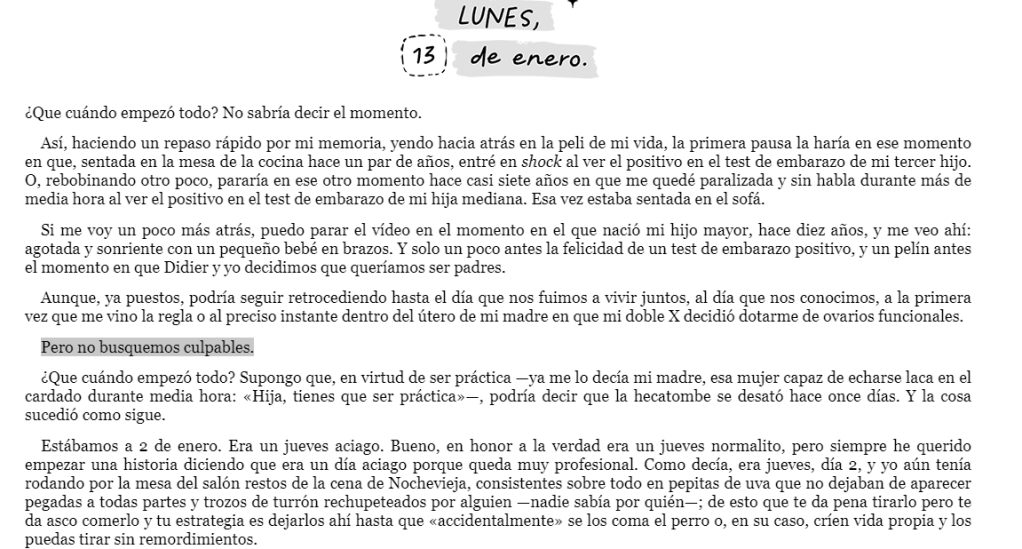
Here below, you’ll find a paragraph of the book I chose to read, and this is the part I want to share with you. This way, you may have a better idea of the content in case you are looking for similar books to read. 😊

Source

MONDAY,

January 13th.

You ask when did everything start? I wouldn’t know when.

Well, doing a quick review of my memory, going back to the movie of my life, I would first stop on the moment when, sitting at the kitchen table, a couple of years ago, I was shocked when I saw the positive pregnancy test of my third child. Or rewinding a bit more, I would stop at another moment, seven years before, when I got paralyzed and speechless for more than half an hour while I was looking at the positive pregnancy test of my middle daughter. At that time, I was sitting on the couch. If I turn back a little more, I can stop the movie at the moment when my oldest son was born, ten years ago, and I see myself there: exhausted but smiling with a baby in my arms. And a bit before that, seeing the happiness of a positive pregnancy test, and a bit earlier when Didier and I decided to be parents.

And now that we are at this point, I could go back to the day when we went to live together, to the day when we met each other, to the first time that I got the period or to the exact moment inside of the uterus of my mother where my double X decided to give me functional ovaries.

But let’s not try to look for the guilty.

Are you asking me when it all started? I suppose that, by being practical- my mom, that woman, able to put lacquer on that carded hair for half an hour, already told me that: ” Daughter, you must be practical”-, I could say that the massacre was unleashed eleven days ago. And the thing happened as follows.

It was the 2nd of January, a fateful Thursday. Well, to be honest, it was a normal Thursday, but I have always wanted to begin a story by saying that it was a fateful day because it looks very professional. As I was saying, it was Thursday, the 2nd, and I still had the remains of the New Year’s Eve dinner rolling around the living room table. They were consistent especially in grape seeds that did not stop appearing glued everywhere with pieces of nougat well sucked by someone- nobody knew by whom-; with the feeling of sadness to throw it away even if it sucked to eat it, but my strategy was to leave them there till the dog could “accidentally” eat them or, in their case, they could have their own life and you could throw them away without any remorse.

(…)

How does it sound to you? I hope you’ll get a chance to read it whether in Spanish or in English. I’ll leave here below the links in case you are interested:

mamá En Busca Del Polvo perdido: Amazon.es: Gómez, Jessica: Libros

Also you can search for Ana Galvez Rodriguez and Laura Solas Fernandez on Facebook and Instagram 🙂 if you want to learn more about their interesting female world 🙂

Ana Gálvez Rodríguez | Facebook

Laura Solas Fernandez | Facebook

HAPPY READING!

Source

HOW DO YOU FEEL?

Good Morning,

Have you ever found yourself in a situation where the people around you start speaking in a language you do not understand? This can be frustrating, especially in international environments where different cultures and languages are present. Sometimes, individuals from the same country may begin conversing in their native language, not considering that others in the group may not understand. While it is important to speak your mother tongue, it is equally important to be mindful of others’ feelings. I have been in situations where people were speaking in Polish or Chinese, and I could not understand a word, which made me feel left out.

Let us strive to be more inclusive when sharing our native languages in international settings. Thank you!

I must admit, I have made that mistake myself. I have spoken my own language in front of people who did not understand it and realized how uncomfortable it can be. It is awkward for the person who does not speak your language or the predominant language in that setting. They might think you are talking about them, even if you are not, which can make them feel excluded.

What I am trying to convey is that if you are in an international group (such as a mix of French, Italian, Colombian, etc.) and there is a common language that everyone understands, like English or Norwegian here in Norway, use that language. Do not wait for your Italian friend and start speaking Italian when no one else understands. It is simply not polite. However, if you are alone with someone from your own country, feel free to speak your language.

Speaking your language in front of others who do not understand it is not the way to gain positive attention. It does not make you look cool; it just makes you appear as a showoff.

Therefore, whenever you are in a group of people who speak different languages, if there is any doubt about being understood, just switch to a common language.

It is all about respect and consideration.

What do you think about this? Has it ever happened to you? How did you feel?

Source

Cultural factors

Greetings everyone,

How are things going?

I decided to write this article about the significant differences between cultures because I find this subject fascinating. I am referring to those details that, according to our culture, we take for granted, while others may take them seriously or personally.

Factor 1: Today, I discovered that in Chinese culture, writing an email signifies the need to discuss a serious matter or warn someone about something. This contrasts starkly with our daily use of emails for reminders, communication, or simply to discuss everyday life.

Factor 2: I noticed that here in Norway, after a day at work, a reunion with friends, or an outing, Norwegians have the habit of saying, “Takk for i dag!” which means “Thank you for today.” For instance, we Italians do not say this, possibly because we tend to take time spent with others for granted. In contrast, Norwegians take nothing for granted and express their gratitude, a practice I have adopted myself. We should learn to appreciate such details. Similarly, after meals, Norwegians say, “Takk for maten!” which means “Thank you for the food!” This is something I have never encountered in my country, and I find it so intriguing that I am learning to say it despite it not being my habit.

Factor 3: In Spain and Latin America, I noticed that everyone calls each other “amor/tesoro/mi vida,” etc., meaning “love/honey/my life,” and many other affectionate nicknames even if they have just met. This practice starts practically from day one! It is entirely different in Italy, where we use such nicknames only when we are well-acquainted with someone. Let me remind you that I left Italy 14 years ago, and surely some things have changed since then. Perhaps they are more passionate than us.

Factor 4: We Italians hug frequently, a habit not shared here in Norway. I recall a few years ago when I went to Italy with a Norwegian friend for a wedding. I couldn’t stop greeting and hugging people because it had been a long time since I had seen them or had the opportunity to be with them. Upon returning to Norway, my friend remarked, “I had such a great time, but I have never seen so many hugs in a day!” What is normal for us is not for them, and vice versa.

Do you know more cultural differences between other countries?

The world is beautiful because of its variety!

culture-word-
Source

Did you know that?

Hello Everyone and Welcome to Sunny Days!

Finally, we have some summer days here in Norway, and having them here is big news!

Today, I would like to share my thoughts on two articles that I have found particularly interesting lately:

Why Do People Throw Rice at Newlyweds?

According to an article I read online, in ancient times, cereals were considered a symbol of prosperity. Bread has always been a staple in our daily lives, and traditionally, brides would incorporate spikes of wheat into their hairstyles, while grooms would place a wheat pie on their heads to serve to guests after the ceremony. Guests would throw almonds and nuts at the newlyweds as a wish for children. Over time, dried fruit was replaced by rice, which continues to symbolize prosperity and abundance. Recently, petals of roses, soap bubbles, or feathers are also thrown to the bride and groom, as rice can sometimes get in their eyes or soil their dresses. Curious, isn’t it?

Why Are Pizza Boxes Square?

Another intriguing fact is the reason behind the square shape of pizza boxes. As children, we learned to recognize geometric shapes and fit them into the correct slots in educational toys. This might explain why the question “Why are pizza boxes square?” arises. Pizza makers often create round pizzas that are not perfectly circular. Placing these in square boxes allows for variances in size. Additionally, producing a square box is cheaper than a round one because it requires only one sheet of cardboard, whereas a round box would need two sheets plus extra time to cut the angles precisely. The side holes in square boxes are necessary to let steam escape, preventing the pizza from continuing to cook and becoming burnt. Interesting, isn’t it?

Learning new things, especially about everyday items we take for granted, is always fascinating.

I hope you enjoyed my post and have a wonderful summer, even in these unusual times.

Follow my posts and please share your opinions.

FL-Ready-Curiosity-Leadership-2400-1
Source