The opposite way!

Hello Everyone,

In a previous article, I discussed the foreign words that we Italians use in our daily lives and at work. This time, I thought it would be interesting to look at the opposite—foreigners who use Italian words.

Let’s consider some examples:

Food: Words like pizza, pasta, spaghetti, tiramisù, risotto, and cappuccino are widely used internationally.

Classical Music: Terms such as adagio, vivace, allegro con brio, aria, and opera lirica are integral to the vocabulary of classical music.

Expressions: The phrase “la dolce vita” has become famous thanks to Federico Fellini’s wonderful film. It embodies the Italian spirit of enjoying life to the fullest.

Transportation: Names like Vespa, Lamborghini, Maserati, Alfa Romeo, and Fiat are globally recognized. Although most of them are surnames, they are distinctively Italian.

Paparazzi: This word is used internationally to describe photographers who relentlessly pursue celebrities. Unfortunately, it implies that these famous individuals have no private life.

Greetings: The word “ciao” is famous worldwide. While in Italian, we use it both to greet and say goodbye, in other languages, it is mainly used to say goodbye. Curious, right?

Mafia: Regrettably, the word “mafia” is one of the most recognized Italian words worldwide. I feel a bit ashamed because, every time someone asks me where I’m from and I say “La bella Italia,” they often respond with “Oh, Berlusconi, bunga bunga, mafia.” Not funny at all.

I believe Italy is one of the most beautiful countries in the world, filled with art, history, culture, stunning beaches, and so much more. I am genuinely proud to be Italian!

As you can see, Italian words are everywhere. Why do foreigners use them? Simply because they do not have proper translations in their own languages. This is different from our tendency to use English words to feel cool and a bit more international. They use Italian words because they need to, not because it’s trendy.

For now, I will say goodbye in my way:

Ciao ciao! 🙂

italy

Source

What time is it?

The Significance of Time in Our Daily Lives

Time” is a small word with immense importance in our everyday lives. Everything revolves around it: every moment and every minute we take is a step toward organizing our daily activities. We often live as if our time is running out, which is somewhat accurate, but sometimes we should slow down and enjoy every moment fully.

We tend to plan our days with some sort of agenda, organizing our routines and scheduling specific appointments or errands. But how do we ask “What time is it?” and respond to this question in Italian, Spanish, English, Portuguese, and Norwegian?

The inspiration for this article came from an experience I had recently. I overheard a Norwegian person abbreviate the proper way of stating the time, and I wondered, “Is that possible?” After considering how he should have said it, I understood why he omitted the full phrase—it takes quite a long time to say it in Norwegian! Before we delve into the Norwegian way of telling time, let’s examine how it is done in other languages.

Italian: In Italian, we ask, “Che ore sono?” (we use the plural form to inquire about the time of day). The response is, “Sono le undici” (it is eleven o’ clock) or “È l’una” (it is one o’ clock). We use the singular form for the number one and the plural form for other numbers. The time can be stated in both digital and analog formats. In this article, I will focus on the analog format because it involves more words in the sentence: “Sono le undici e venti!” (it is twenty past eleven) or “Sono le tre meno un quarto!” (it is a quarter to three). “E” is “past“/right side of the clock and “meno” is “to“/left side of the clock.

Spanish: In Spanish, the question is, “¿Qué hora es?” or “¿Qué horas son?“—both singular and plural forms are used. The answer is always in the plural form, except for one o’clock, which is singular, just like in Italian. “Son las quince y veinticinco” (it is twenty-five past three PM) or “Son las cuatro menos cinco” (it is five to four). On the right side of the clock, they use “y” (and), and on the left side, they use “menos” (to).

English: In English, we ask, “What time is it?” and respond with, “It is twelve o’ clock” or “It is ten to ten!” The singular form is used here. When telling time in English, remember that “past” is used for the right side of the clock (e.g., “it is a quarter past three“), while “to” is used for the left side (e.g., “it is twenty to four“).

Portuguese: Portuguese follows the same pattern as Spanish. They ask, “Que hora é?” or “Que horas são?” and answer with, “São as cinco para onze” or “É a uma e cinco“. “Para” is used to mean “to” (left side of the clock), and “e” is used for “past” (right side of the clock).

Norwegian: Finally, let’s analyze the Norwegian way, which led me to write this article. They ask, “Hva er klokken?” The answer can be complex. For the first quarter on the right side of the clock, they say, “Det er fem tjue” (it is five twenty). For the last quarter, they say, “Det er kvart på fire” (it is a quarter to four). The challenge, particularly for immigrants, comes with phrases like “Det er ti/fem på halv ett” which translates literally to “It is ten/five minutes to the half-hour to one” (meaning “it’s twelve twenty/twenty-five”). For the left side of the clock, they say, “Det er fem/ti over halv tre”, meaning “it is five/ten minutes past the half-hour to three” (i.e., “twenty/twenty-five minutes to three“).

Considering this explanation, I recall the phrase I heard: “Er det ti over?” (He asked, “Is it twenty to…?“)—a significant abbreviation! He should have said, “Er klokken ti over halv elleve?” (Is it twenty to eleven?).

I often wonder why people complicate their lives. What is complicated and “strange” for some might be simple and easy for others. It just takes time to memorize how certain things work.

And I appreciate that!

cartoon_face_large_clock-r32cf18472ea843f69edc3b3bbc8e267f_fup13_8byvr_307

Source

We don’t speak Italian!

The Evolution of Modern Italian: An International Influence

It is evident that the Italian we speak today has become quite international, primarily due to our habit of incorporating numerous foreign words into our daily conversations. As a result, it often doesn’t sound like a purely national language anymore. We adopt many loanwords from different cultures, not only because they are concise and help us communicate more quickly, but also because they make us appear “cool.” By “cool,” I mean sophisticated in our linguistic abilities, and our globalized society requires us to demonstrate our open-mindedness.

We frequently mix different languages into our own, such as:

Italian: Ci sentiamo questo weekend? Così ti mando il link del file che mi hai chiesto.

Translation: Shall we call each other this weekend? So I can send you the link of the file you asked me.

Italian: Ho bisogno di una babysitter.

Translation: I need a babysitter.

Italian: Dobbiamo trovare una bella location questo weekend per fare delle foto.

Translation: We have to find a nice location this weekend to take some pictures.

In these examples, approximately 30-50% of the sentences are in English, even though we are speaking Italian. The amusing part is that each of these words has a proper Italian translation, which we rarely use:

Weekend: fine settimana

Link: collegamento

File: cartella

Babysitter: tata

Location: posto, luogo

As you can see, we have numerous opportunities to elevate our language by using these Italian terms in our everyday speech. However, we often prefer the foreign words, possibly because we have become somewhat Americanized!

We might consider following the example of Spanish speakers, who translate almost everything from English to Spanish. They do this out of nationalism and a strong desire to preserve and promote their national language.

What are your thoughts on this? Do you mix different languages in your speech as well?

english-phrases-1
Source

The world of the dictionary

Today, with the advent of the Internet, the use of traditional dictionaries has diminished. The new generation may not even know how the pages of a dictionary smell or how enjoyable it can be to search for words manually!

A dictionary provides comprehensive explanations about words, and as I continue reading “L’italiano è bello” (Italian is Nice) by Mariangela Galatea Vaglio, I have discovered intriguing information about the origins of the very first Italian dictionary and the first academy that validates every new word to be accepted as part of the Italian language.

At the end of the 16th century, Italians spoke a vernacular language. Following Dante’s works in the 14th century, which were written in a more elegant Florentine Italian than the vernacular, writers thought to establish a grammar for the Florentine language. They believed that having rules would simplify writing and speaking for themselves and future writers.

In 1583, The Accademia della Crusca was founded. If translated into English, it would be The Bran Academy, metaphorically representing the language ground in all its words, which are like cereals. Initially, it was a club where writers gathered to discuss literature and linguistic issues. Today, it serves as the national and official academy where new Italian words are incorporated into the language.

In 1612, the first Italian dictionary was published. All words were listed in alphabetical order, and each word included several examples based on different contexts.

All of Europe began to follow the Italian example. This undoubtedly helped the writers of that time and continues to aid modern writers.

I emphasize the importance of keeping dictionaries alive and actually using them, as their main purpose is to educate, inform, and enrich our intelligence.

The book I’m reading is fascinating, and I will certainly share more insights from it in future articles. There is always something new to learn!

Do you use your native language dictionary?

Source

What am I?

Are You Curious? Do You Want to Train Your Brain?

What do you think about riddles? A riddle is an excellent exercise for our brains. It is quite useful for enhancing our intelligence, attention, and speed in understanding what the riddle is talking about.

As the Cambridge Dictionary explains, a riddle is a type of question that describes something in a difficult and confusing way and has a clever or funny answer, often asked as a game; something that is confusing or a problem that is difficult to solve. Please check: Cambridge Dictionary – Riddle

Here are some riddles in the five languages I speak. Let’s see who can guess them:

Italiano- Riddle: La mia vita può durare qualche ora, quello che produco mi divora. Sottile sono veloce, grossa sono lenta e il vento molto mi spaventa. Chi sono?

Español- Riddle: Lleva años en el mar y aún no sabe nadar.

English- Riddle: What can travel around the world while staying in a corner?

Português- Riddle: Somos muitos irmãozinhos em uma só casa vivemos, se nos coçam a cabeça, num instante morremos.

Norsk- Riddle: Hvem er det som er sønn av mine foreldre, men likevel ikke min bror?

Isn’t this cool? Let’s try to guess them!

Please write the answers if you know them!

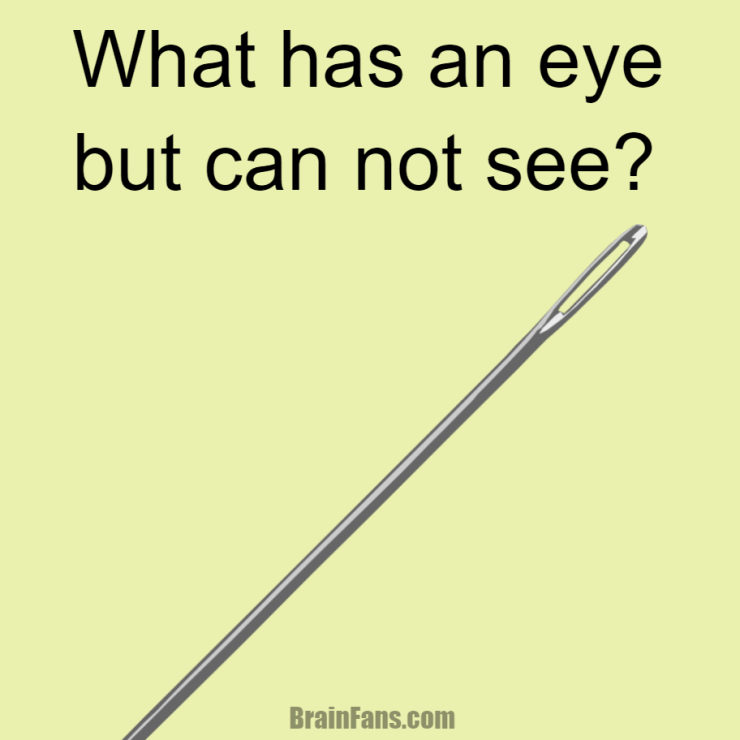
brain-teaser-logic-riddles-what-has-an-eye-but-cannot-see-1658557895593452f40de0b1.80044688
Source

Answers: Italiano- La candela; Español- La arena; English- The stamp; Portugués- Os fósforos; Norsk- Meg selv.